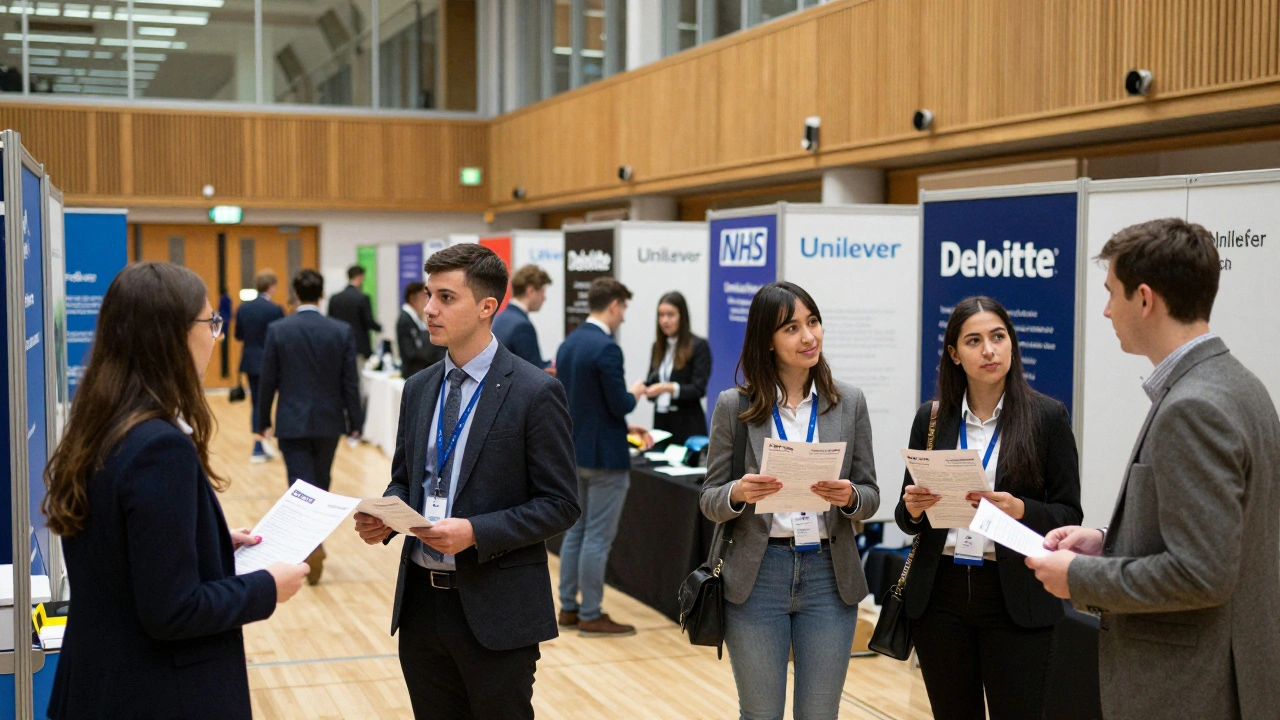
Every year, tens of thousands of students across UK universities walk into career fairs expecting a magic ticket to a job. Some leave with five business cards and no follow-ups. Others walk out with internships, graduate offers, and real connections. What’s the difference? It’s not luck. It’s preparation.
What You’re Really Walking Into
Career fairs at UK universities aren’t just booths with free pens and snacks. They’re live job markets. Companies like Deloitte, Unilever, NHS, and Rolls-Royce send teams specifically to recruit from campuses. In 2025, over 80% of UK universities reported that more than 60% of their graduating students received job offers through these events. That’s not a coincidence. It’s strategy.
But here’s the truth: most students treat these events like a casual stroll through a shopping mall. They hand over their CVs without a word, stare at screens showing company logos, and leave. That’s not how you get noticed.
Before the Event: Do This First
Don’t wait until the day of the fair to get ready. Start three weeks out.
- Research the companies attending. Most universities publish a full list a week before the event. Pick the top 5 you actually want to work for. Go to their graduate recruitment pages. Read their mission statements. Know their latest projects.
- Customize your CV. One-size-fits-all doesn’t work. If you’re applying to a tech firm, highlight your coding projects. If it’s finance, show your analytical internships. Tailor your CV so it answers their unspoken question: “Why should we pick you over 200 others?”
- Practice your pitch. You have 30 seconds. That’s all. Start with: “Hi, I’m [Name], a final-year [Course] student at [University]. I’m interested in [Role] because [specific reason tied to their work].” End with: “I’d love to hear what you’re looking for in candidates.”
- Bring printed copies. Digital resumes don’t get passed around. Print 15-20 copies on good quality paper. No colour, no graphics-just clean, professional text.
At the Fair: How to Stand Out
Walk up to a booth. Don’t hover. Don’t wait for someone to call you. Say hello. Make eye contact. Smile.
Here’s what works: Ask a smart question. Not “What do you do?” That’s lazy. Try: “I read your recent report on AI in supply chains. How are you training graduates to handle ethical AI decisions?” Or: “I noticed you’ve hired 12 graduates from this uni last year. What made them successful?”
These questions show you did your homework. They also trigger a conversation. People love talking about their work. And if you spark that, you’re no longer just another student. You’re someone they remember.
Don’t just collect business cards. Get names. Ask: “Can I connect with you on LinkedIn?” Then say it clearly: “I’m [Name], [Course] at [University]. I’d appreciate connecting so I can follow your team’s work.” Most recruiters will say yes.

What Companies Are Really Looking For
They don’t need perfect grades. They need people who show up, speak up, and follow through.
Here’s what recruiters from top UK firms told us in 2025 interviews:
- Initiative: “We see hundreds of students with 2:1s. But only a few who showed up at our workshop last semester. That’s the one we remember.” - HR Lead, KPMG
- Clarity: “If you can’t explain in 20 seconds why you want this role, we assume you don’t really want it.” - Recruitment Manager, HSBC
- Follow-up: “We get 500 CVs. If you email us two days later with a specific question about our project, you’re in the top 5%.” - Graduate Hiring Director, BT
That’s the pattern. It’s not about being the smartest. It’s about being the most prepared and the most human.
Don’t Skip the Side Events
Most students go to the main fair and call it a day. Big mistake.
Many universities run company-specific workshops the week before or after the fair. These are smaller, quieter, and way more valuable. You’ll get 10 minutes with a hiring manager. No crowd. No noise. Just a real conversation.
Some universities also host mock interviews or CV clinics with alumni. Use them. One student from Manchester told us she got her job at Accenture because she fixed one line on her CV during a 15-minute clinic. That line? “Led a team project” → “Led a 4-person team to deliver a 30% efficiency gain for a local charity.” Specifics matter.
After the Event: The Real Game Begins
Showing up is half the battle. Following up is the other half.
- Within 48 hours, send a short LinkedIn message to each recruiter you talked to. Mention something specific: “Great talking to you about your work on sustainable logistics. I’d love to hear more about your graduate programme.”
- Check the university’s job portal. Many companies post openings only to students after the fair. Set up alerts.
- If you didn’t get an offer, ask for feedback. Say: “I really appreciated our chat. Would you be open to a quick 10-minute call next week to help me understand where I could improve?” Most will say yes.
One student from Bristol applied to 12 companies after her fair. She got 3 interviews. She got 1 offer. She turned it down because she waited two weeks to follow up with another company-and got a better offer. Timing isn’t everything. But not following up? That’s a guaranteed no.

Common Mistakes (And How to Avoid Them)
- Mistake: Wearing jeans and a hoodie. Solution: Business casual. Button-down shirt, blazer, clean shoes. You don’t need a suit. But you do need to look like you take this seriously.
- Mistake: Talking only about grades. Solution: Talk about projects, clubs, volunteering. Employers care more about what you’ve done than what you scored.
- Mistake: Forgetting to ask questions. Solution: Always have one ready. Even if it’s simple: “What’s the biggest challenge your grads face in their first six months?”
- Mistake: Not tracking who you met. Solution: Keep a simple notebook. Name. Company. Topic. Next step. It takes 10 seconds per person.
What If You’re Not a STEM Student?
You don’t need to be an engineer to benefit. Universities bring in employers from law, media, charities, public sector, arts, and even tourism.
For example, the National Trust, BBC, and Amnesty International all have active graduate programs. If you studied history, English, or sociology, your critical thinking and communication skills are exactly what they need.
Focus on transferable skills: writing reports, managing teams, organizing events, solving problems. Frame your experience that way. “I ran a campus campaign that increased participation by 40%” is just as powerful as “I coded an app.”
Final Thought: It’s Not About the Fair
The career fair is just a starting point. The real opportunity is what you do before, during, and after.
Thousands of students attend these events every year. Only a few get noticed. The ones who do? They didn’t wait to be found. They showed up prepared, spoke with purpose, and followed through.
You can be one of them.
Do I need to pay to attend university career fairs?
No. Career fairs at UK universities are free for all enrolled students. Some events may require pre-registration through the university’s careers portal, but there is never a fee. Be cautious of third-party sites asking for payment-those are scams.
What if I’m a first-year student? Is it worth going?
Absolutely. Many companies offer internships and work placements for first- and second-year students. Attending early helps you understand what employers want, build your network, and get feedback on your CV. You might even land a summer internship that leads to a full-time offer later.
How do I find out which companies are attending?
Check your university’s careers service website or portal. Most publish a list 7-10 days before the event. Some also send emails or post updates on student Facebook groups. If you can’t find it, email the careers office directly-they’ll send you the details.
Can international students benefit from these events?
Yes. Many UK employers actively recruit international students, especially those with visas like the Graduate Route. Companies like Google, PwC, and the NHS have clear policies supporting international hires. Make sure to mention your visa status if asked-it’s not a barrier, it’s part of the conversation.
What if I’m not sure what job I want?
That’s okay. Go with curiosity. Talk to companies in different sectors. Ask: “What kinds of people succeed here?” or “What does a typical graduate role look like?” You don’t need to have it all figured out. You just need to start exploring.