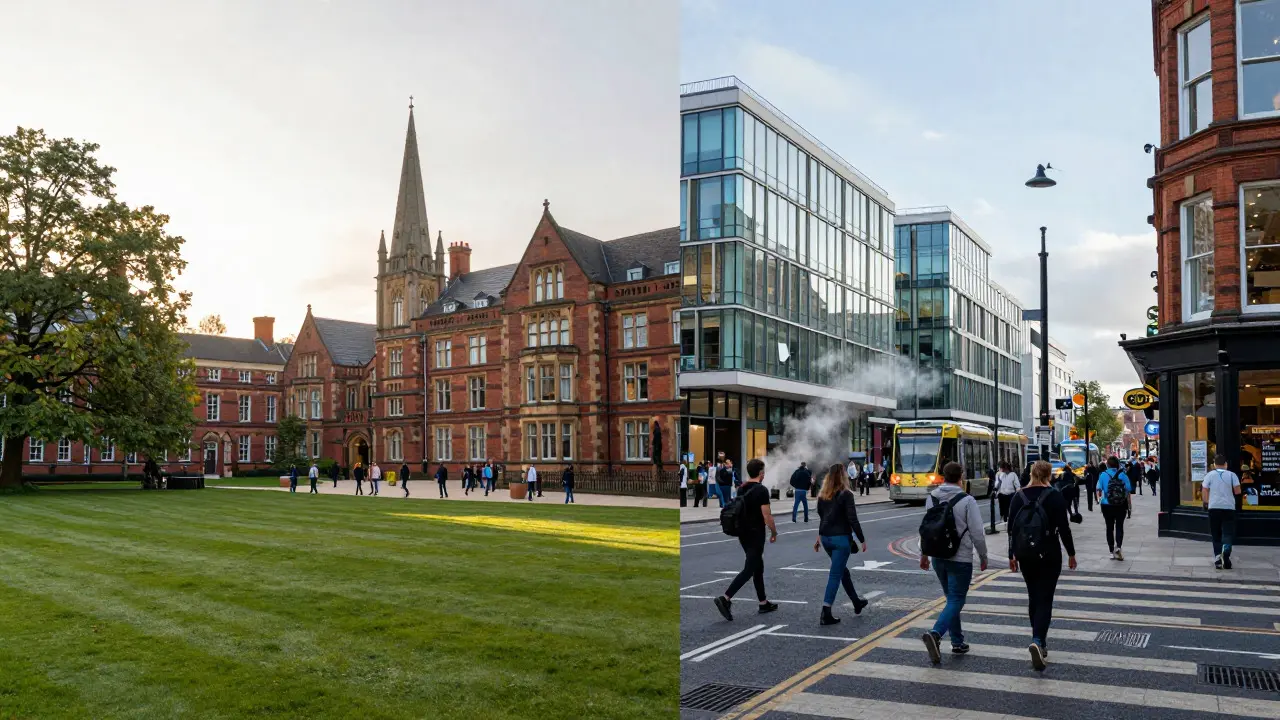
Imagine waking up to the sound of birds chirping on a quiet green lawn versus the hum of traffic and the smell of fresh coffee from a nearby café. Both are valid ways to start a day at a UK university is an institution of higher education that offers undergraduate and postgraduate degrees across various disciplines. But which one fits your life? Choosing between a traditional campus-based university is a self-contained academic environment usually located outside major urban centers with dedicated residential facilities and a city university is an institution integrated into an urban landscape where classes are held in buildings scattered throughout the town or city center isn't just about prestige. It dictates your daily routine, your budget, and even how you socialize.
This decision impacts more than just where you sit during lectures. It shapes your independence, your exposure to local culture, and your financial reality for three to four years. Let's break down the real differences so you can pick the environment that actually supports your goals.
The Daily Rhythm: Structure vs. Freedom
Campus universities operate like small towns within cities. You walk from your dorm room to the library, then to the lecture hall, all within a five-minute radius. This proximity creates a structured rhythm. Your days are defined by class times, meal halls, and organized societies. If you thrive on routine and want a clear separation between "study time" and "home time," this setup works well. The community is tight-knit because everyone shares the same physical space.
City universities flip this model. Classes might be in different buildings across the city. One morning, you're in a historic building near the river; the next, you're in a modern glass tower downtown. This requires more planning. You need to manage transport, track opening hours of libraries that might close early, and navigate public spaces. However, this freedom allows for a more flexible schedule. You can slip out for a part-time job, attend a cultural event, or explore the city without feeling like you're leaving a closed bubble. For students who hate being cooped up, this open layout feels liberating rather than chaotic.
Accommodation Costs and Living Arrangements
Money is often the deciding factor. Campus universities typically offer managed halls of residence. These come with bills included (internet, electricity, heating) and sometimes meals. While they can feel restrictive, they provide a safety net. In the 2025/2026 academic year, average prices for standard en-suite rooms in university-managed halls range from £130 to £180 per week. Luxury options push past £250 per week, but they include concierge services and premium locations.
City universities rarely have large-scale on-campus housing. Instead, you rent private flats or share houses with other students. This option offers more space and privacy. A single room in a shared flat in a city like Manchester or Birmingham might cost £150 to £200 per week. However, you must pay utilities separately, which adds £30 to £50 per person monthly. The trade-off is clear: campus halls are predictable and inclusive; city rentals are variable but offer adult-like living conditions. If you want to cook your own meals and control your own thermostat, city living wins. If you want zero hassle, campus halls are safer.
| Factor | Campus University | City University |
|---|---|---|
| Location | Isolated or semi-rural grounds | Integrated into urban center |
| Housing Type | Managed halls, purpose-built residences | Private rentals, shared flats |
| Weekly Cost Range | £130 - £250 (bills included) | £150 - £200 + £30-£50 utilities |
| Social Environment | Structured, student-focused communities | Diverse, mixed-age interactions |
| Commute Time | Walking distance (5-15 mins) | Public transport required (15-45 mins) |
Cultural Exposure and Social Life
Your social circle forms differently in each setting. On a campus, your peers are primarily fellow students. Societies, sports teams, and college events create a dense network of friendships. It’s easy to make friends quickly because everyone is new and looking for connection. The downside? You might miss out on the broader world. Your view of society is filtered through the lens of other 18-to-22-year-olds.
In a city, you’re surrounded by professionals, families, tourists, and locals. This diversity enriches your perspective. You might work a weekend shift in a bar run by a family business, volunteer with a local charity, or attend a gallery opening. These experiences build soft skills like adaptability and communication that don’t always happen inside a campus bubble. City students often report feeling more "grown-up" by their second year because they navigate real-world logistics daily. Campus students often describe a stronger sense of belonging and security, knowing help is always nearby in a familiar place.

Academic Atmosphere and Resources
Both types offer high-quality teaching, but the vibe differs. Campus universities often have larger, centralized libraries and research facilities. The focus is heavily academic. You’ll find quiet study zones, extensive archives, and specialized labs that are hard to replicate elsewhere. The atmosphere is conducive to deep work. Distractions are minimal because the environment is designed for learning.
City universities leverage their location for industry connections. Many have strong ties to local businesses, offering internships, placements, and guest lectures from professionals. If you’re studying law, journalism, or finance, being in the heart of the action matters. You can network over lunch instead of waiting for a career fair. Libraries in city universities might be smaller or split across multiple sites, requiring you to check specific branch hours. But the practical application of knowledge is often faster here. You learn by doing, not just reading.
Transport and Mobility
On a campus, you likely won’t need a car. Walking and cycling are the primary modes of transport. Buses connect the main gates to nearby towns if you need groceries. It’s simple and low-cost. Your carbon footprint is lower, and you save money on fuel and insurance.
In a city, transport is complex. You’ll rely on buses, trams, trains, or tubes. Getting around takes time. A 10-minute walk on campus becomes a 30-minute journey involving transfers in the city. You need to buy travel passes, which can cost £40 to £80 per month depending on the city. However, this mobility opens up opportunities. You can visit other cities for weekends, access better shopping, and enjoy a wider range of entertainment. Just budget for it. Transport costs add up fast if you’re not careful.

Choosing Based on Personality and Goals
There is no objectively "better" option. The right choice depends on who you are. Ask yourself these questions:
- Do I need structure? If yes, choose a campus. The built-in schedule helps you stay on track.
- Am I independent? If yes, a city university suits you. You’ll handle your own logistics and thrive on variety.
- What is my budget? If funds are tight, compare total costs including hidden expenses like utilities and transport. Sometimes the cheaper rent in a city is offset by higher living costs.
- What do I want to achieve? If you want immediate industry exposure, go to a city. If you want to focus purely on academics and research, a campus provides that focus.
Consider hybrid models too. Some universities have main campuses but also satellite sites in city centers. Check if your specific course is taught on the main campus or in the city. This detail changes everything. Don’t assume the whole university operates under one model.
Practical Tips for Your Decision
Before committing, take a virtual tour or visit in person if possible. Walk the routes. See where the libraries are. Check the noise levels. Talk to current students, not just staff. Staff will tell you the official story; students will tell you the reality. Ask them about the hardest part of their commute and what they miss most about home. Their answers will give you a realistic picture of daily life.
Also, look at the surrounding area. Is there good public transport? Are there supermarkets nearby? What is the safety record of the neighborhood? These factors affect your quality of life more than the ranking of the university itself. A top-ranked university in an inconvenient location can be stressful. A mid-tier university in a vibrant, accessible city can be a rewarding experience.
Frequently Asked Questions
Are campus universities harder to get into than city universities?
Not necessarily. Admission requirements depend on the specific course and university reputation, not the physical layout. A prestigious city university may have stricter entry criteria than a mid-range campus university. Always check the individual course page for A-level or IB requirements.
Which type is better for international students?
Many international students prefer campus universities initially because the support systems are centralized. Orientation programs, visa advice, and English language support are often easier to access on a compact campus. However, city universities offer better practice for adapting to British urban life, which can help with future employment.
Can I switch from a campus to a city university after the first year?
Yes, transferring is possible but competitive. You would need to apply through the standard admissions process, often as a Year 2 transfer. Credits may or may not transfer depending on curriculum alignment. It’s a significant step, so ensure you have a clear reason for the move before starting the paperwork.
Do city universities have fewer extracurricular activities?
They often have similar numbers of societies, but the activities are less centralized. Instead of a single sports center, you might join a climbing gym in the city center or a music club in a local venue. The variety is wider, but you have to seek out the opportunities rather than having them presented to you in a student union building.
How does the weather impact campus vs. city living?
In bad weather, campus life becomes insular. You stay indoors, use the library, and eat in the dining hall. City life requires braving the elements to get to class. This can be tiring but builds resilience. Many city students develop a habit of checking weather forecasts religiously and planning outfits accordingly. Campus students often ignore the forecast until they’re already walking outside.