
Ever submitted a brilliant essay only to have your marker flag it for "inconsistent register" or "grammatical errors"? In the UK, academic writing isn't just about getting your ideas across; it's about adhering to specific conventions that signal you belong in that scholarly conversation. The difference between a First and a 2:1 often lies not in your argument, but in how cleanly you construct your sentences.
This guide cuts through the noise. We’re not talking about basic spelling checks. We’re looking at the structural and stylistic traps that trip up even advanced students when they transition from casual communication to formal UK Academic Writing is a formal style of writing used in British higher education institutions that prioritizes objectivity, clarity, and strict adherence to grammatical standards such as Oxford commas and specific punctuation rules. It requires a distinct approach to sentence structure, vocabulary choice, and citation formatting compared to other regional styles. contexts.
Key Takeaways
- Comma Splices are the Silent Killer: Avoid joining two independent clauses with just a comma. Use a semicolon, a period, or a conjunction.
- The Oxford Comma is Non-Negotiable: In lists of three or more items, place a comma before the final conjunction (and/or).
- Passive Voice Has a Place: Use it to emphasize the action or result, not to hide responsibility, but don’t overuse it to sound "smart."
- Formality is Contextual: Avoid contractions (don’t use "don't"), slang, and first-person pronouns unless explicitly permitted by your module guide.
- Punctuation Reflects Logic: Semicolons and colons show relationships between ideas; misuse them, and your logic appears weak.
The Punctuation Pitfalls That Markers Hate
If there is one thing that instantly lowers the perceived quality of an academic paper, it’s inconsistent punctuation. Let’s start with the most common error: the comma splice. This happens when you join two complete sentences with only a comma. For example, writing "The experiment failed, the data was corrupted" is technically incorrect. Each part is a full thought. To fix this, you have three options: split them into two sentences, use a semicolon ("The experiment failed; the data was corrupted"), or add a coordinating conjunction ("The experiment failed, and the data was corrupted").
Next, consider the Oxford comma. While some US styles debate its necessity, UK academic conventions generally favor it for clarity. If you write "I cited Smith, Jones and Brown," a reader might briefly wonder if "Jones and Brown" is a single entity. Adding that final comma-"I cited Smith, Jones, and Brown"-removes all ambiguity. It’s a small mark, but it signals precision.
| Error Type | Incorrect Example | Corrected Example | Why It Matters |
|---|---|---|---|
| Comma Splice | The theory is flawed, it lacks evidence. | The theory is flawed; it lacks evidence. | Shows logical separation of independent ideas. |
| Missing Oxford Comma | We used Python, R and SPSS. | We used Python, R, and SPSS. | Prevents ambiguity in lists of three or more items. |
| Misused Colon | The results were: significant. | The results were significant. | Colons introduce explanations or lists, not simple predicates. |
| Dangling Modifier | Walking to the lab, the rain started. | Walking to the lab, I saw the rain start. | Ensures the subject performing the action is clear. |
Mastering Formal Tone and Register
Academic writing demands a specific register. You aren’t texting a friend; you’re presenting arguments to a critical audience. The first rule is eliminating contractions. "Don’t" becomes "do not." "It’s" becomes "it is." These small changes increase the formality of your text without adding complexity.
Secondly, watch your word choice. Words like "stuff," "things," and "get" are too vague for academic discourse. Instead of "We got the results," write "We obtained the results." Instead of "This stuff is important," specify what "this stuff" refers to. Precision is key. When you say "the phenomenon," ensure the reader knows exactly which phenomenon you mean from the previous sentence.
What about the first person? For decades, UK academia frowned upon "I" and "we." Today, many disciplines accept "we" when describing methodology (e.g., "We conducted the survey...") because it clarifies who performed the action. However, avoid using "I" in analytical sections unless your discipline specifically encourages personal reflection. Check your department’s style guide. If in doubt, stick to third-person or passive constructions where appropriate.

Sentence Structure: Clarity Over Complexity
A common mistake among aspiring academics is the belief that longer sentences sound smarter. They don’t. Long, winding sentences often obscure meaning and make it hard for the reader to follow your logic. Aim for variety, not length. Mix short, punchy sentences with complex ones that contain subordinate clauses.
Consider this example: "Although the initial hypothesis suggested a positive correlation, the subsequent data analysis revealed no significant relationship, which contradicted the findings of previous studies." This is a good complex sentence. Now compare it to: "The data showed nothing which was weird because earlier papers said yes so we were confused about why the numbers didn't match up." The second version is informal, vague, and logically weak. The first uses precise terminology ("significant relationship," "contradicted") and clear connectors ("although," "which"). Your goal is to make the reader work less, not more. Every sentence should advance your argument clearly.
Active vs. Passive Voice: Knowing When to Switch
Many students are taught to "avoid passive voice." This is outdated advice. Passive voice has a legitimate role in academic writing. Use active voice when the actor is important: "Smith (2023) argued that..." Use passive voice when the action or result is more important than who did it: "The samples were heated to 100°C."
In scientific methods sections, passive voice is standard because it keeps the focus on the procedure rather than the researcher. In literature reviews, active voice helps attribute ideas to specific authors. The key is consistency. Don’t switch back and forth randomly within the same paragraph. Choose based on emphasis. If you find yourself writing "It is believed that..." repeatedly, try to identify who believes it and name them. Vague agents weaken your authority.
Citation and Reference Consistency
Grammar mistakes extend beyond syntax. Inconsistent referencing is a major issue. Whether you use Harvard, APA, or OSCOLA, consistency is non-negotiable. A common error is mixing in-text citation formats. For instance, using (Smith, 2020) in one sentence and Smith (2020) in the next is acceptable, but switching between date-only citations and full author-date citations without reason confuses the reader.
Also, watch out for "citation islands." This happens when you cite a source once and never mention it again, or when you list sources in the bibliography that aren’t actually cited in the text. Both suggest sloppy editing. Run a reference check before submission. Ensure every in-text citation has a corresponding entry in your reference list, and vice versa.
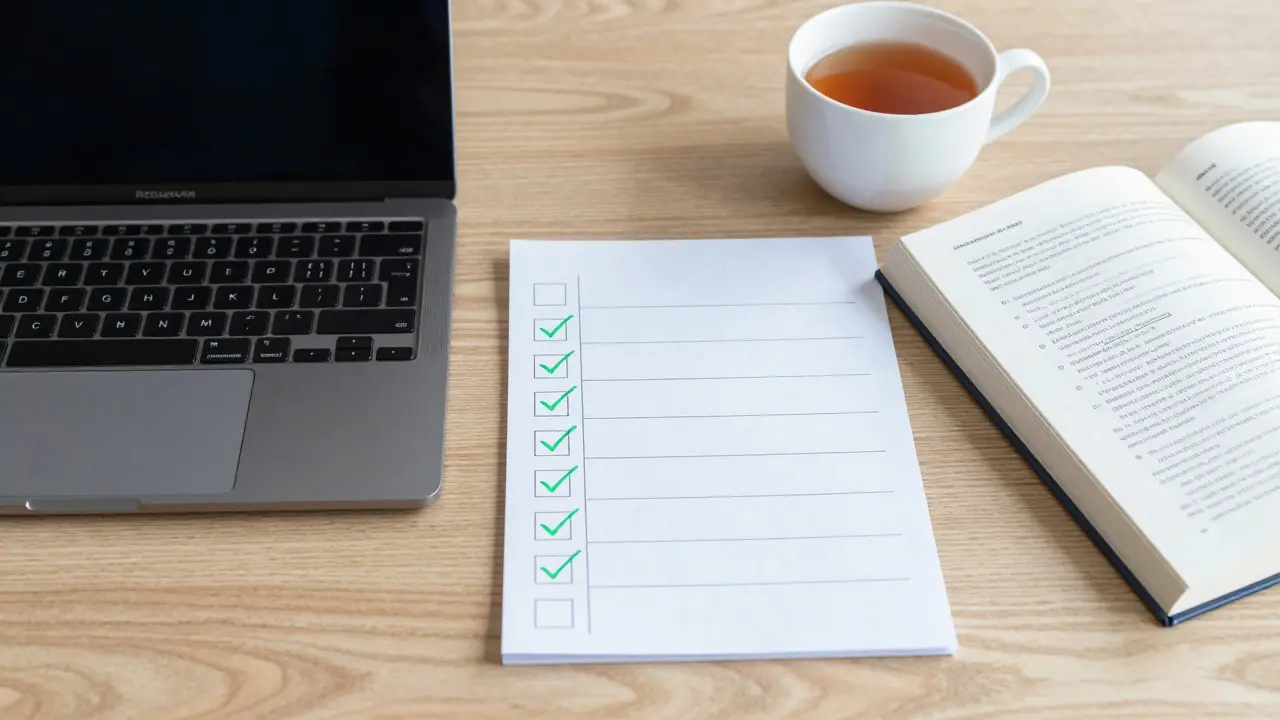
Practical Checklist Before Submission
Before you hit submit, run through this quick checklist. It takes five minutes and can save your grade.
- Read Aloud: Read your document aloud. If you stumble over a sentence, your reader will too. Break it up.
- Check Contractions: Search for "'t" and "'re" to catch any remaining informal contractions.
- Verify Punctuation: Look for comma splices. Replace single commas between independent clauses with semicolons or periods.
- Review Word Choice: Replace vague words like "good," "bad," "many," or "some" with specific quantifiers or adjectives.
- Confirm Citation Style: Ensure your reference list matches your department’s required format exactly. Even spacing and indentation matter.
- Check for Repetition: Use synonyms or restructure sentences to avoid repeating the same phrase multiple times in close proximity.
Frequently Asked Questions
Is passive voice always bad in academic writing?
No. Passive voice is useful when the focus is on the action or result rather than the doer. For example, "The solution was mixed" is better than "We mixed the solution" in a methods section because it emphasizes the process. Use it strategically, not habitually.
Should I use the Oxford comma in UK academic writing?
Yes, it is generally recommended in UK academic contexts to prevent ambiguity in lists of three or more items. While not strictly mandatory in all style guides, it enhances clarity and is widely accepted in higher education institutions.
How long should my sentences be?
There is no strict limit, but aim for readability. If a sentence exceeds 40-50 words, consider breaking it into two. Complex ideas require complex sentences, but clarity should always take precedence over length.
Can I use first-person pronouns in my essay?
It depends on your discipline and year of study. In humanities, third-person is still preferred. In sciences and social sciences, "we" is often acceptable for describing methodology. Always check your module guide or ask your tutor for specific guidance.
What is a comma splice and how do I fix it?
A comma splice occurs when two independent clauses are joined by only a comma. Fix it by using a period, a semicolon, or adding a coordinating conjunction (like "and" or "but") after the comma.