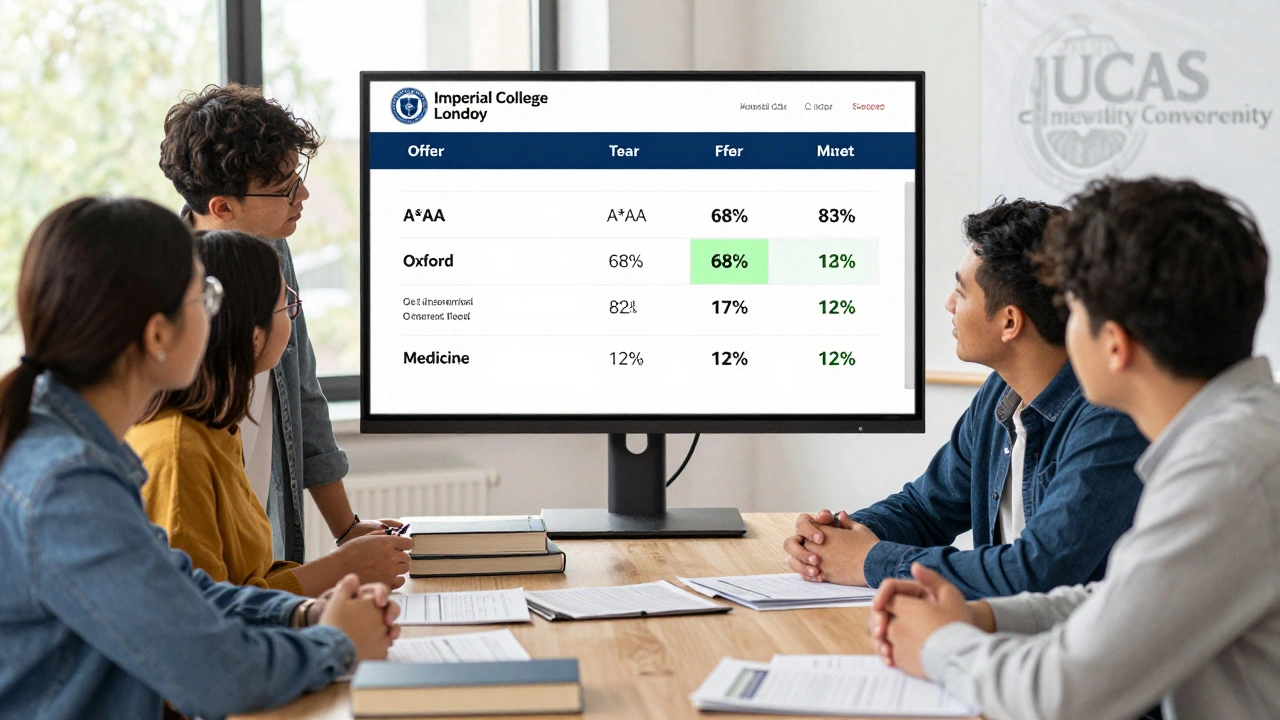
Getting into a UK university isn’t just about having good grades. It’s about understanding how competitive each school is, what grades they actually accept, and how offer rates vary between courses and institutions. If you’re applying from outside the UK-or even if you’re a local student-you need real data, not vague advice.
What Are Offer Rates, Really?
An offer rate is the percentage of applicants who get at least one offer from a university. It sounds simple, but it’s often misunderstood. A high offer rate doesn’t mean the school is easy to get into. It might mean they receive far more applications than they have spots. For example, University of Manchester had an offer rate of 84% in 2025, but only 58% of those offers were accepted. That means over 40% of students who got in chose another school.
On the flip side, Oxford and Cambridge had offer rates around 68% and 71% respectively in 2025. Lower offer rates? Not because they’re rejecting more people-they’re just selective. They receive 5 to 7 applications for every spot. A 70% offer rate at Oxford means they still turn away 3 out of 10 qualified applicants.
Typical Grades: What Do Successful Applicants Actually Have?
Most universities publish their entry requirements-like AAB or BBB. But what do students who actually get in usually have? The answer isn’t always what you think.
For top 10 UK universities in 2025, the average A-level grades of enrolled students were:
- Imperial College London: A*AA (with A* in Maths or Science)
- University College London: AAA
- University of Edinburgh: AAB
- King’s College London: AAA
- University of Bristol: AAB
These aren’t the minimums. These are the typical grades. If you’re applying to Imperial with ABB, you’re not just below the bar-you’re far below the average. That doesn’t mean you can’t get in, but your personal statement, references, and extracurriculars need to be exceptional.
For international students, the equivalent is trickier. A US GPA of 3.7+ is generally competitive for top schools. IB students need 38+ points. But again, it’s not just about the number. A student with 36 IB points and a published research paper in a science journal might get into Cambridge over someone with 42 points and no standout achievements.
Course Matters More Than University
Many students think applying to “a good university” is enough. But the competitiveness of your course can be far more important than the school’s overall ranking.
At the University of Nottingham, the offer rate for Medicine was 12% in 2025. For Psychology? 68%. Same university. Same admissions team. Totally different pools of applicants.
Here’s how it breaks down for 2025:
- Medicine: 10-15% offer rate across all UK universities
- Dentistry: 12-18%
- Engineering: 45-60%
- Computer Science: 50-70%
- English Literature: 75-85%
- Education: 80-90%
If you’re applying for a high-demand course, your grades need to be near the top. For low-demand courses, you might get in with slightly lower scores-but you’ll still need a strong personal statement that shows genuine interest.
How UCAS Points Work (And Why They Don’t Tell the Whole Story)
UCAS tariff points convert your qualifications into a single number. A* at A-level = 56 points. An IB score of 40 = 180 points. Sounds straightforward? It’s not.
Most universities don’t use UCAS points to make decisions. They look at subject-specific grades. A university might say “120 UCAS points” on their website, but they’ll still require an A in Biology if you’re applying for Biomedical Sciences.
Why? Because a student with ABB (120 points) might not be ready for a science degree if their B in Chemistry was borderline. But a student with A*AC (136 points) might be stronger in the core subject.
UCAS points are a filter. Your actual grades are the real test.
International Students: What You Need to Know
International applicants make up over 20% of the UK’s undergraduate population. But they face different hurdles.
First, many UK universities don’t accept every international qualification. The US high school diploma? Only accepted by some schools. The Indian CBSE? Accepted, but with higher grade requirements. The French Baccalaureate? Often accepted, but with specific subject requirements.
Second, English language scores matter more than you think. A 6.5 IELTS is the minimum for most universities. But for competitive courses like Law or Medicine, they often expect 7.5 or higher-even if the official requirement is lower.
Third, interviews and portfolios are common. Royal College of Art, for example, requires a portfolio for every applicant. King’s College London interviews 40% of international applicants for Economics. You can’t just send grades and hope for the best.

What Gets You Rejected-Even With Good Grades
It’s not just about grades. In 2025, 18% of applicants with AAA or higher were rejected from at least one top university. Why?
- Generic personal statements: “I’ve always loved science since I was a child” doesn’t cut it anymore. Admissions officers read 100s of these. You need specifics: a lab project, a book that changed your thinking, a volunteer experience that sparked your interest.
- Weak references: A teacher who writes “Student is hardworking” won’t help. A reference that says “Student led a peer tutoring group that improved class averages by 15%” stands out.
- Applying to too many competitive courses: If you apply to Medicine, Dentistry, and Law all in one go, admissions teams notice. It looks like you’re applying randomly, not because you’re passionate.
- Missing deadlines: UCAS deadline is January 15. Late applications? Almost never accepted.
How to Gauge Your Chances
Here’s a simple way to check if you’re in the right range:
- Find the university’s average accepted grades (not the minimum) for your course. Use UCAS’s Course Search tool.
- Compare your grades. If you’re 1 grade below the average, your personal statement needs to be outstanding.
- If you’re 2 grades below, you’re likely not competitive unless you have a major exception (e.g., national competition win, published work).
- Check the offer rate. If it’s below 40%, assume you’re competing with top-tier applicants.
For example: You have AAB. You’re applying to University of Warwick for Economics. The average accepted grade is AAB. Offer rate: 52%. You’re right on target. Your personal statement needs to show why you’re not just another AAB student-you’re the one who read The Undercover Economist and wrote a blog analyzing local rent prices.
What to Do If You Don’t Get In
Rejection isn’t the end. In 2025, 23% of UK students who didn’t get into their first-choice university ended up at a different institution and were just as happy-or more so-by graduation.
Options:
- Clearing: Many universities with lower offer rates (like Cardiff, Southampton, or Newcastle) still have spots in July. You can get into a top 30 school through Clearing with BBB grades.
- Gap year: Use it to gain experience. Volunteer, intern, or take an online course in your field. It strengthens your application next year.
- Transfer: Some students start at a less competitive university, do well in Year 1, and transfer to a top school. This works best for STEM subjects.
One student from Texas applied to five UK universities with 3.8 GPA and got rejected everywhere. She took a gap year, worked at a nonprofit analyzing education policy, and reapplied with a detailed personal statement and a letter from her supervisor. She got into University of Edinburgh.
What’s the easiest UK university to get into?
There’s no single "easiest" university, but some have higher offer rates and lower grade requirements. Universities like the University of Central Lancashire, University of Bedfordshire, and University of West London had offer rates above 85% in 2025. For these schools, typical accepted grades were around BBC or equivalent. However, "easiest" doesn’t mean "least valuable." Many of these schools have strong programs in areas like nursing, social work, and digital media.
Do I need A*s to get into a top UK university?
Not always. Top universities like UCL and Edinburgh accept students with AAA or AAB. But for courses like Medicine, Engineering, or Computer Science at Oxford or Imperial, A*s in key subjects are common among successful applicants. What matters more is meeting the subject-specific requirements and showing depth in your chosen field.
Can I get into a UK university with a 3.2 GPA?
Yes, but only for less competitive courses and universities. A 3.2 GPA is roughly equivalent to BBB at A-level. You’ll have good chances at universities like Keele, Liverpool, or Manchester Metropolitan for subjects like History, Psychology, or Business. For competitive courses like Law or Medicine, a 3.2 GPA will likely lead to rejection unless you have extraordinary extracurriculars or work experience.
Are offer rates the same for domestic and international students?
No. International students often face stiffer competition because universities have limited spots for them. For example, at the University of Edinburgh, the offer rate for UK students in 2025 was 73%, but for international students, it was 51%. This is because international applicants are not capped by the same government funding rules as UK students, so universities can be more selective.
How important are extracurriculars in UK admissions?
They matter more than you’d expect. Unlike in the US, UK universities don’t look for a long list of activities. But they do want to see one or two meaningful commitments. For example, running a school science club, volunteering at a hospital, or publishing a blog on climate policy shows initiative. A generic "I played soccer" won’t help. A detailed story about how you organized a fundraising campaign for a local clinic? That stands out.
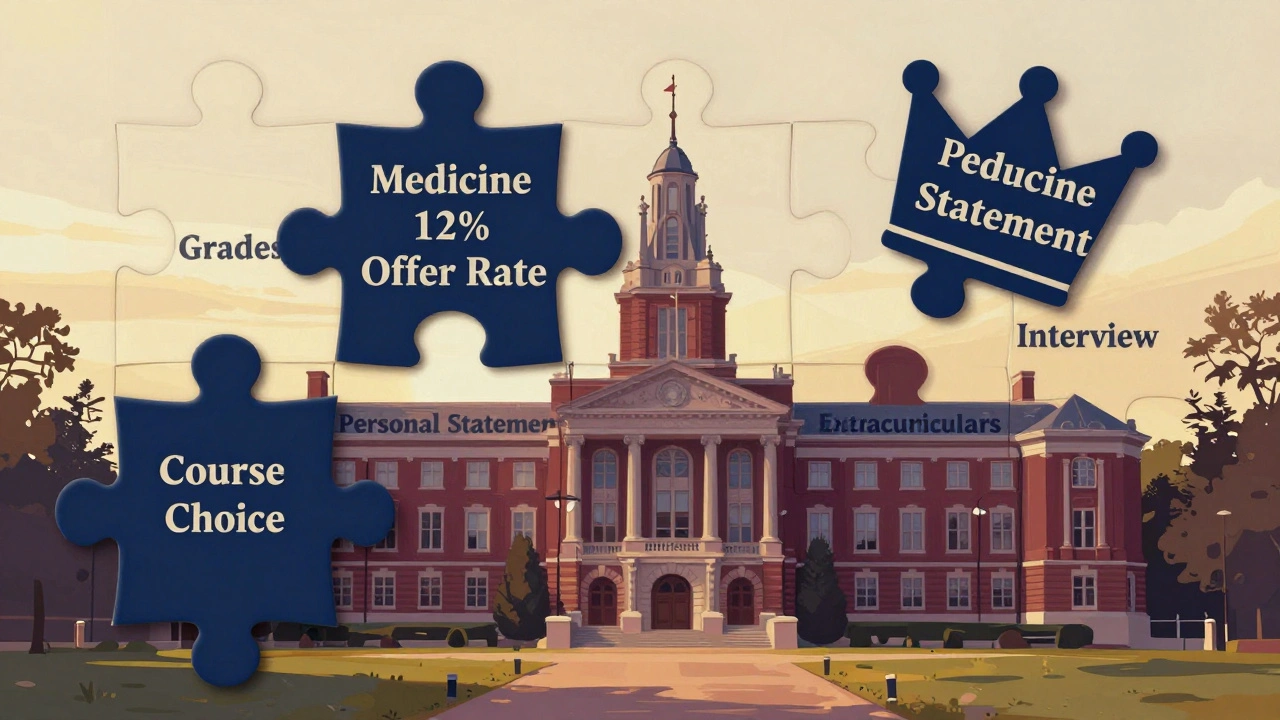
UK university admissions are not a lottery. They’re a puzzle. You need the right grades, the right course choice, and the right story. Don’t just aim for a high-ranking school. Aim for the school and course where your profile fits-not just meets the minimum.