Ever submitted a paper to a UK journal is a publication outlet adhering to specific academic standards in the United Kingdom only to get rejected before peer review? It might not be your data. It could be your abstract or keywords. In the UK academic landscape, these two elements are the gatekeepers. If they don’t signal clarity and relevance, editors often skip the full text entirely.
This guide breaks down exactly what to include in your abstract and how to choose keywords that actually help researchers find your work. We’ll look at the structural norms in British academia, common pitfalls, and practical strategies to make your metadata work harder for you.
Why the Abstract Matters More Than You Think
An academic abstract is a concise summary of a research paper that outlines the purpose, methods, results, and conclusions. For UK-based institutions and journals, this isn’t just a formality; it’s a standalone document. Many librarians and search engines index abstracts separately from the full text. If your abstract doesn’t stand on its own, your paper becomes invisible in database searches like Scopus is a comprehensive abstract and citation database covering scholarly literature or Web of Science is a platform for indexing high-quality scholarly content.
The standard length for most UK journals is between 150 and 300 words. Always check the specific author guidelines is instructions provided by publishers detailing formatting and submission requirements. Some medical journals require structured abstracts with labeled sections (Background, Methods, Results, Conclusion), while social science journals often prefer unstructured paragraphs. Getting this wrong can lead to immediate desk rejection.
Structuring Your Abstract for Clarity
Whether structured or unstructured, your abstract needs a logical flow. Here is a reliable framework that works across disciplines:
- Context & Problem: Start with one sentence establishing why the topic matters. Avoid broad generalizations. Be specific about the gap in current knowledge.
- Objective: State clearly what your study aimed to do. Use active verbs like "investigated," "analyzed," or "compared."
- Methods: Briefly describe your approach. Mention the sample size, location, timeframe, and key techniques. Specificity builds credibility.
- Results: Provide the main findings. Include key statistics if relevant (e.g., p-values, effect sizes). Don’t list every result; focus on the headline numbers.
- Conclusion: Summarize the implication. What does this mean for the field? Keep it to one or two sentences.
Avoid jargon that isn’t defined elsewhere. Remember, readers scanning abstracts may not be specialists in your exact niche. Write for an educated generalist in your broader field.
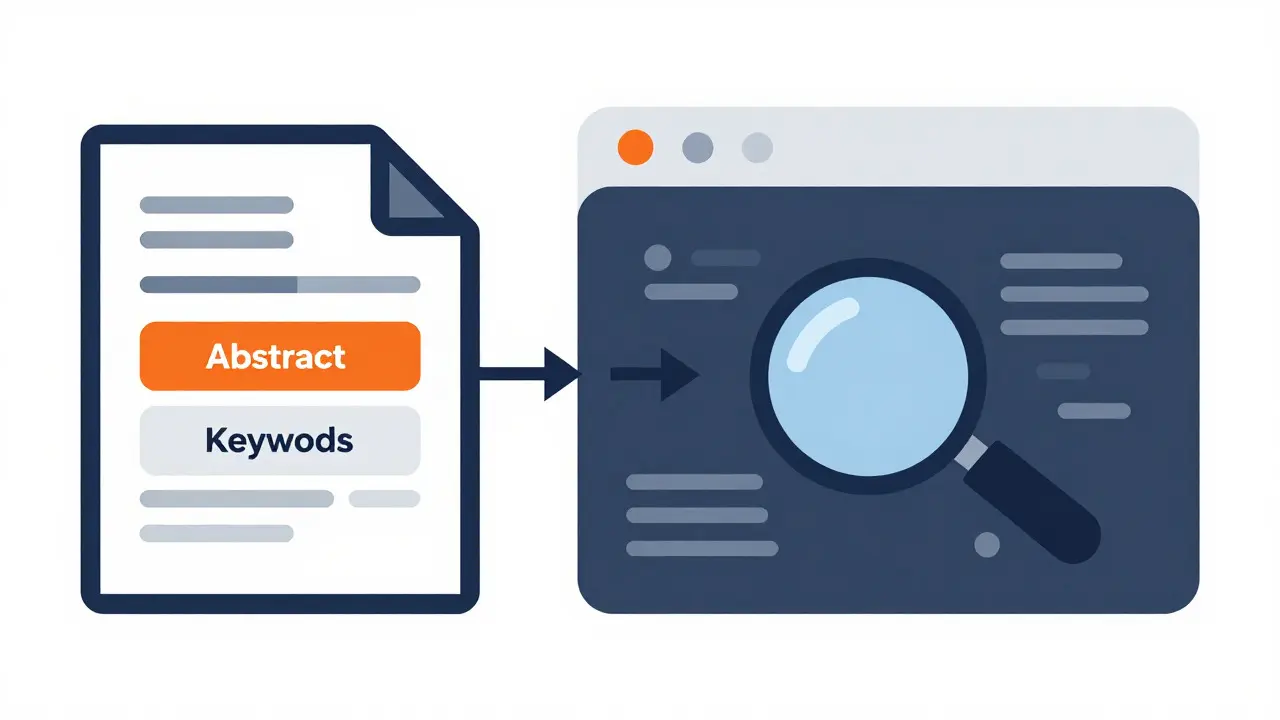
Choosing Effective Keywords
Keywords are the bridge between your paper and potential readers. In the UK system, using standardized terms is crucial because many databases rely on controlled vocabularies.
Most UK journals ask for 3 to 6 keywords. Here is how to select them:
- Use Controlled Vocabularies: Check if your field uses a specific taxonomy. For example, medical papers should use MeSH terms is Medical Subject Headings, a controlled vocabulary used for indexing articles in PubMed, while social sciences might align with PsycINFO is a bibliographic database for psychology and related fields descriptors. Using official terms increases discoverability significantly.
- Mix Broad and Specific Terms: One or two broad terms establish the field (e.g., "Education Policy"). The rest should be specific to your study (e.g., "Curriculum Reform," "Northern England").
- Avoid Redundancy: Don’t use synonyms as separate keywords. If you use "Childhood Obesity," don’t also list "Obesity in Children." Pick the most precise term.
- Include Methodological Terms: If your method is novel or central to the contribution, include it. For instance, "Qualitative Interview" or "Longitudinal Study."
Common Pitfalls to Avoid
Even experienced researchers make mistakes here. Watch out for these frequent errors:
- Citing Sources in the Abstract: Unless explicitly required, avoid citations in the abstract. It clutters the text and looks unprofessional. Save references for the main body.
- Using Abbreviations Without Definition: If you must use an acronym, define it on first use in the abstract. However, it’s often better to spell out the term if space allows.
- Overstating Conclusions: Stick to what the data supports. Phrases like "proves" or "definitively shows" are red flags for reviewers who value nuance.
- Ignoring Journal Specifics: A journal focused on applied research may want practical implications highlighted, whereas a theoretical journal may prioritize conceptual contributions. Tailor your emphasis accordingly.

Practical Example: Before and After
Let’s look at a hypothetical paper on urban planning in Manchester.
Poor Abstract: "This paper talks about cities. We looked at some streets in Manchester. People liked the changes. It was good. Cities need more green spaces."
Better Abstract: "Urban regeneration in post-industrial cities remains a complex challenge. This study investigates the impact of green infrastructure on pedestrian traffic in Manchester, UK. Using a mixed-methods approach combining sensor data (n=50 sensors) and semi-structured interviews (n=45 residents) over six months, we analyzed usage patterns before and after park installation. Results showed a 22% increase in daily footfall within a 500m radius. These findings suggest that targeted green interventions can effectively revitalize underused urban zones, offering a replicable model for similar UK cities."
Notice the difference? The second version includes specific metrics, clear methodology, and a grounded conclusion. It respects the reader’s time and intelligence.
Final Checks Before Submission
Before you hit send, run through this quick checklist:
- Does the abstract fit the word count limit?
- Are all abbreviations defined?
- Do the keywords match the journal’s preferred vocabulary?
- Is the tone objective and confident but not arrogant?
- Have you removed any unnecessary background info?
Your abstract and keywords are the first impression of your hard work. Treat them with the same care as your introduction. They determine whether your research gets seen, cited, and discussed. Take the extra ten minutes to refine them, and you’ll likely see a higher response rate from editors and readers alike.
How long should a UK research paper abstract be?
Most UK journals require between 150 and 300 words. Always verify the specific author guidelines for your target publication, as some specialized fields may have stricter limits.
Should I use MeSH terms for my keywords?
If you are publishing in a medical or health-related journal, yes. MeSH terms improve indexing in PubMed. For other fields, use the controlled vocabulary recommended by your discipline's major databases, such as PsycINFO for psychology or EconLit for economics.
Can I include citations in my abstract?
Generally, no. Citations clutter the abstract and distract from your core message. Only include them if the journal explicitly requires referencing prior work in the summary section.
What is the difference between structured and unstructured abstracts?
A structured abstract uses headings like 'Methods' and 'Results' to organize information. An unstructured abstract flows as a single paragraph without labels. Medical journals typically require structured formats, while humanities and social sciences often accept unstructured ones.
How many keywords should I provide?
Standard practice in the UK is 3 to 6 keywords. Ensure each keyword adds distinct value and avoids redundancy with other terms in your list.